
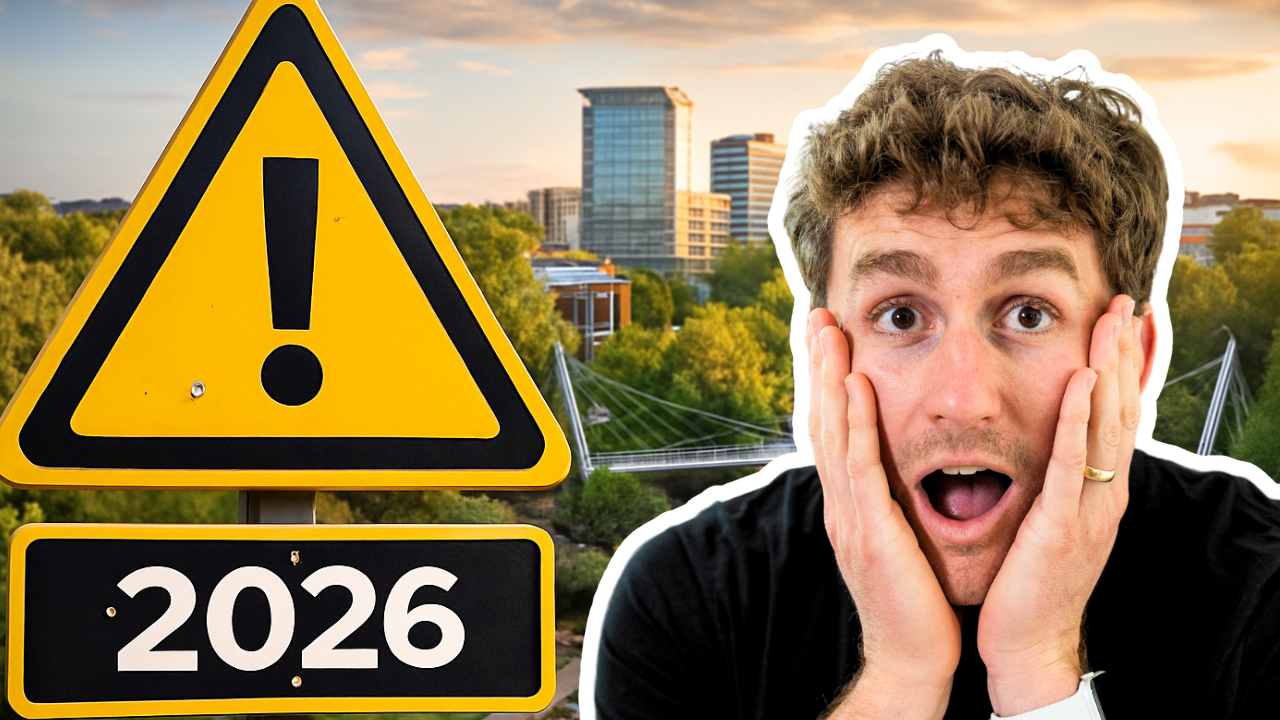
If you’re considering a move to Greenville, SC in 2026, you’re not alone. Our city has exploded in popularity over the last few years — and as someone who lives here, works here, and has helped over 300 families buy or sell real estate across the Upstate, I can tell you firsthand: Greenville is still an incredible place to call home.
But the Greenville that existed in 2020 isn’t the same Greenville that’s heading into 2026.
Yes — the highlight reel you see online is real. The parks, the food scene, the Swamp Rabbit Trail, the world-class downtown. But if you’re planning a move here, you need more than a highlight reel. You need context. You need the real story behind how the city is changing, how the market is shifting, and what life here actually looks like day to day.
That’s exactly what this guide is for.
We’re breaking down the cost of living, the real estate trends, how Greenville is growing, where it’s struggling, and — most importantly — what those changes mean for you if you're planning a move in 2026.
Is Greenville’s Real Estate Market Still Strong Going Into 2026?
While many metro areas across the country have seen cooling demand, declining prices, and rising days on market, Greenville continues to stand out. In 2025:
Average sales price: ≈ $400,000
Year-to-date appreciation: +4%
Closed sales: Up roughly 9% year over year
This makes Greenville one of the most affordable mid-sized metro markets in the U.S. with ongoing price stability and demand.
People aren’t moving here and leaving disappointed — they're staying, building community, and putting down roots.
The most consistently high-demand areas include:
Simpsonville / Five Forks
Pelham Road corridor (Eastside Greenville)
Travelers Rest (near the Blue Ridge Mountains)
Downtown Greenville’s walkable neighborhoods
Long-time favorites that continue to lead demand:
Weatherstone (Simpsonville)
Stillwaters at Lake Robinson (Taylors)
Brighton and Carisbrooke (Greer)
Fast-growing communities gaining buzz:
Tubbs Mountain Estates (Travelers Rest)
The Settlement (Simpsonville)
The Sinclair (Downtown Greenville)
Durbin Meadows (Fountain Inn)
If you're planning to relocate, these areas give you a sense of where the strongest lifestyle + value combinations exist right now.
The Real Challenges Greenville Is Facing (And What They Mean for 2026 Relocation)
Greenville is an amazing place — but it isn’t perfect. And transparency is a huge part of making your move successful.
Here are the four challenges future residents should be aware of:
1. Home Prices Have Risen Quickly — and Consistently
Greenville is still “affordable” by national standards, but affordability is decreasing more quickly than most people realize.
Average Sales Price Progression:
Dec 2021: ~$330K
Dec 2022: ~$350K
Dec 2023: ~$367K
Dec 2024: ~$376K
That's nearly a 25% increase in a short window.
Meanwhile:
Other metros have flattened or declined post-COVID
Greenville’s closed sales are still climbing
Demand continues to outpace supply in key suburbs
If affordability is a key factor in your move, you need to begin planning early — especially if you're targeting highly desired school zones or amenity-heavy neighborhoods.
That said, you can still find:
Plenty of homes under $400K, and
Abundant options above $600K across all major suburbs
But the days of “surprisingly inexpensive Greenville” are gone.
2. Infrastructure Hasn’t Kept Up With Population Growth
Growth is good — until the roads don’t match it.
Traffic patterns have changed dramatically in just 2–3 years in a few corridors:
Woodruff Road
Pelham Road
Highway 25 toward Travelers Rest
Fork Shoals Road / 29605 corridor
Ashmore Bridge Road
Ranch Road (especially at rush hour)
And yes — I-85 from 3pm–6pm is reliably stop-and-go.
One area of concern heading into 2026 is the 29605 / Fork Shoals corridor. Thousands of new homes are underway, yet the primary access road is still a two-lane road.
This doesn’t make the area unlivable — it just means you need to understand the pace of growth before committing.
Realistically, traffic is not improving anytime soon because many state-planned improvements have been pushed back several years.
3. Summers Are Hot — Especially the Evenings
Daytime heat isn't the biggest shocker. It's the evenings.
In July and August:
It’s often still above 80°F after dark
Humidity is higher than most Midwest and Northeast transplants expect
I regularly tell clients to visit in June or July if they're heat-sensitive.
One recent client from Maine said it perfectly:
“I’d rather sweat for three months than shovel snow for six.”
And that is exactly how many people relocating here feel.
4. Your Experience Depends on Choosing the Right Suburb
This is arguably the most important factor of all.
Greenville’s suburbs are diverse:
Some are quiet and suburban
Some are bustling and growth-heavy
Some are premium and competitive
Some offer better outdoor access
Some have top-ranked schools but limited inventory
Your ideal lifestyle may match one suburb perfectly and clash with another just 10 minutes away.
When clients reach out early and share:
Their pace-of-life preferences
School needs
Commute patterns
Desired amenities
Budget
…it allows us to match them with areas that feel right — not just “fine.”
Choosing the right suburb can completely transform your experience here.
Choosing the wrong one can make Greenville feel nothing like what you imagined.
Greenville in 2026: The Biggest Projects Shaping the City
As we move into 2026, Greenville is investing heavily in long-term growth, infrastructure, and quality-of-life upgrades.
These are the major changes you’ll feel as a resident:
1. County Square Redevelopment
This massive 40-acre urban transformation is reshaping the west side of downtown with:
New residential options
Restaurants & retail
Office space
A new government complex
Pedestrian-friendly plazas and greenspace
Once complete, downtown will feel significantly larger, more walkable, and more connected.
2. The Greenville Gateway Project
Expected to create a more modern, welcoming entry into downtown through:
Reworked intersections
Better pedestrian connectivity
Streetscape enhancements
More green space
Improved traffic circulation
By 2026, arriving in downtown Greenville will feel noticeably more polished.
3. Laurens Road Corridor Transformation
One of the most exciting growth corridors in Greenville.
Former industrial sites are becoming:
Mixed-use communities
Residential developments
More restaurants and retail
Walkable districts
Additional Swamp Rabbit Trail access points
This corridor will serve as a connective spine between:
Downtown Greenville
Verdae
Eastside Greenville
4. Greenville’s Economic Momentum Continues Accelerating
Greenville’s labor market remains one of the strongest in the Southeast.
Recent announcements include major investments in:
Advanced manufacturing
Life sciences
Technology
Logistics
EV-related industries
These projects will bring thousands of new jobs and hundreds of millions in investment — supporting housing demand and stabilizing long-term appreciation.
Should You Move to Greenville in 2026?
Here’s the bottom line:
Greenville is thriving — but it’s evolving.
If you're coming here expecting 2015 or 2020 Greenville, you’ll be surprised.
If you're coming here ready for growth, opportunity, and a community-oriented lifestyle… you’re going to love it.
But you need to choose the right suburb.
You need to understand traffic patterns.
You need to prepare for rising home prices.
And you need a guide who can help you navigate all of that with data and clarity.
That’s what my team and I do every single day.
READ: Things To Know BEFORE Moving to Greenville SC [2026 Guide]
Thinking About Moving to Greenville, SC?
I’ve helped many families relocate to Greenville, guiding them through the process and helping them find the right fit for their needs.
Contact us for real estate inquiries:
📱 Call or text: 864-688-9738
📧 Email: [email protected]
Subscribe to our YouTube channel for more travel guides and valuable real estate insights in Greenville. Let's make your dreams of calling Greenville home a reality!
Check out this article next