Quick Answer: Where does old money live in Greenville, SC?
You'd think old Greenville money would be hidden behind the biggest gates or inside the newest buildings. But the truth is that it's found on streets that have looked the same for over 100 years.
There are six pockets of the city and mountains where that history lives: Augusta Road, the North Main / Earle Street / Hampton-Pinckney historic districts, the Altamont Road / Paris Mountain / Green Valley area, Chanticleer / Parkins Mill / Collins Creek, Cleveland Forest and Alta Vista, and The Cliffs Communities in the mountains above town.
Each one comes with its own trade-offs: tight inventory, historic-district rules, mountain drive times, or club dues on top of HOA fees. Below, I'll walk through what each one is really like, what it costs, and what to weigh before you go after one of these addresses.
Augusta Road: The Heart of Old Greenville
Walk these streets on a quiet morning and you'll see old shade trees arching over the road, stately homes set back behind mature canopy, and neighbors out walking who've lived here for decades.
Augusta Road is the address everyone with old Greenville money has chased for generations, and younger generations fight to get into. When a home does come up, it tends to sell fast if it's priced well.
The appeal here is simply location. You can take a long walk to downtown and the West End from most of these streets, and downtown Greenville is one of the most walkable cores in the Southeast. Families in the 29605 zip code lean all the way into it. They walk their kids to Augusta Circle Elementary, which ranks among the top five elementary schools in the entire state. In real estate, a ranking like that really helps homes hold their value.
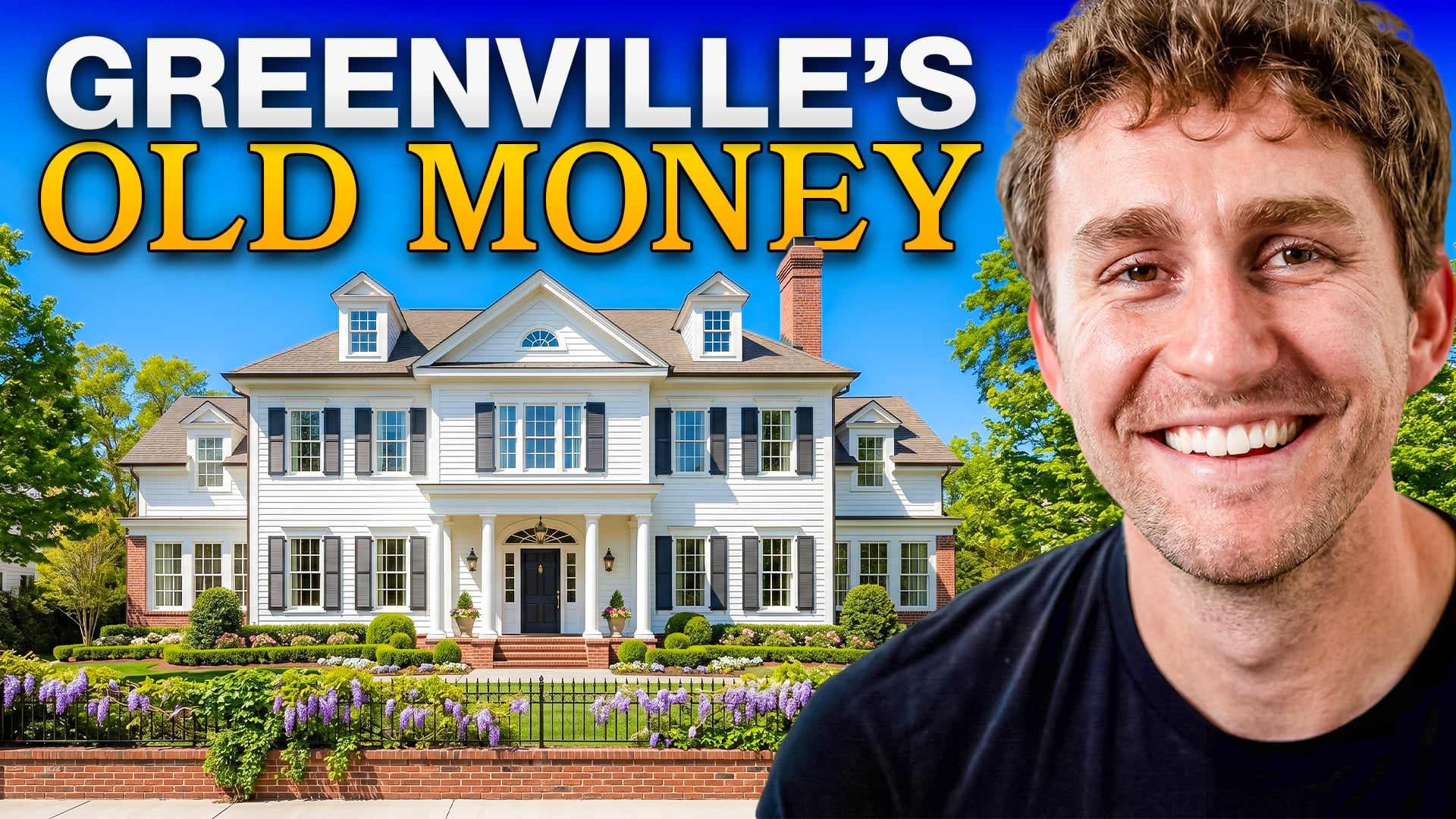
The architecture tells you how layered the history is. You'll see Southern Colonials, brick Tudors, Georgian estates, and beautifully restored Craftsman bungalows. Streets like Crescent Avenue and McIver Street have barely changed in character over the decades.
There's a catch, though: inventory is super tight, so you might wait months for the right home to show up. The neighborhood character is protected, so you can't tear something down and build whatever you want. And depending on your down payment, these homes can push you straight into jumbo loan territory.
So far this year, the average sales price for a home zoned for Augusta Circle is $1.13 million, with days on market averaging 43, well below the average for the broader Greenville market. Compare that to just two years ago, when the average sales price for a home zoned for Augusta Circle was $895,000. As older homeowners begin to sell, the buyers showing up and paying for it are people who want to be zoned for this elementary school, retired folks who want a mature community and an old home with a custom renovation, and younger families who want to be near downtown Greenville and live on Augusta Road.
North Main, Earle Street, and Hampton-Pinckney: Where the City Started
These are some of the oldest residential streets in all of Greenville, where the city first started putting down roots. You can feel that age in every front porch and wrought-iron gate.
The Earle Town House on James Street goes back to the early 1800s, built by a family whose patriarch served in Congress. That kind of pedigree is woven right into the pavement.
You're also within walking distance of downtown, Cleveland Park, and the Swamp Rabbit Trail, which has grown into a network of nearly 30 miles of paved path that now stretches out into the suburbs of Greenville. Living here, you can grab coffee downtown or hit the trail without ever touching your car.
The homes themselves are stunning: early 1900s estates, Queen Annes, and Victorians line streets like Earle Street, James Street, and Bennett Street.
Hampton-Pinckney is the showpiece of this area. It was the first historic district ever designated in Greenville, and the state calls it the finest remaining area of Victorian architecture in the city. Dozens of these homes date back to the late 1800s and early 1900s. And this is no frozen museum: the neighborhood still throws its annual PorchFest, with live music right on the front porches. It's a living, breathing community.
But owning a piece of history comes with rules. These are locally designated historic districts, so there are guidelines on what you can change outside. And homes this old need steady investment in the plumbing and the wiring. Owning one means taking on the upkeep of a piece of Greenville's past.
For prices, this pocket runs from the mid-$600s for a smaller, less updated historic home, up through the high-$800s, and past a million for a fully restored estate on the best streets. For the right buyer, the history is the entire draw.
Altamont Road, Paris Mountain, and Green Valley: Old Money in the Mountains
Drive north out of downtown and the land tilts upward, the air cools, and the city falls away behind you in the rearview.
Paris Mountain sits just a few miles north of downtown, close enough to run a quick errand, high enough to feel like another world. The state park up there spreads across well over a thousand acres, with miles of trails and a few mountain lakes. For folks living on Altamont Road, that's their backyard.
These are the most exclusive pockets on the mountain. You get elevation, long views, and a level of privacy you can't replicate this close to town. The houses are big custom builds on wooded, multi-acre lots, most tucked behind gated drives. There's some history up here too. One property near the top sits on land where old stone stair remnants may tie back to the original Altamont Hotel, a mountain getaway from the late 1800s.
Green Valley pairs that mountain feel with full country club estate living. The neighborhood grew up around a golf course laid out in the late 1950s by George Cobb, the same architect behind work at Augusta National. Because it came together over decades, the homes vary more than you'd expect: mid-century brick Colonials, traditional Craftsman homes, and custom estates on lots that average around an acre and a half. The houses here feel larger, older, and more established than what you find in the newer parts of town.
The trade-offs are practical. The mountain roads on Altamont are steep and winding, and they'll ice over a few days each winter. Green Valley sits about 15 minutes from downtown by car, which is manageable, but you're not walking anywhere from up here.
On price, Green Valley homes range from the high $800s up past two million depending on size and view. Altamont Road estates climb from the mid-to-high single million into the 3-million-plus range for the most exceptional parcels. It's the kind of setting you either pay up for, or you don't. If it's worth the winding drive to you, it's worth every penny.
Chanticleer, Parkins Mill, and Collins Creek: Old Money That Stays in the Family
South of downtown sits some of the oldest money in Greenville, the kind that stays in families for decades. Trade the mountain switchbacks for flat, shady streets and you land in a different kind of wealth here.
Chanticleer, Parkins Mill, and Collins Creek are established luxury enclaves. Chanticleer was laid out more than 50 years ago on the outskirts of Augusta Road, built around rolling, wooded terrain with tree-lined streets and gated pockets, all a short drive from downtown.
The whole area centers on the Greenville Country Club and its Chanticleer course. The club dates back to the 1890s, and the course came straight from the hand of the legendary Robert Trent Jones Sr. It's ranked among the top courses in South Carolina, and that prestige spills right out into the surrounding streets. It just underwent a huge multi-million dollar renovation, which has the membership jumping for joy, since many of them said the course was too hard for the average player. I can attest, even as a former walk-on college golfer, that sucker was tough. This is one of the most esteemed country clubs in all of South Carolina, and when I inquired about membership, I was met with a near four-year waiting list and a climbing initiation fee that would shock most people.
In these communities you'll find brick Colonials, 20th century custom-renovated homes, and now new homes with modern architecture.
Collins Creek, right off Parkins Mill Road, is an absolute showpiece. Lots run from a half-acre up to a couple of acres or more, there's no HOA to deal with, and the homes are mostly custom brick in Traditional and Colonial styles.
Shopping here is tricky, though. The price spread is wide, and it has to do with how recently a home's been updated, since many of these have been owned for decades and haven't been updated, or the updates still reflect a 20th century or 2010 style. Two houses on the same street can be worlds apart depending on whether the inside has been touched in the last decade.
Collins Creek trades from the mid-to-high million range up past $2.5 million. It's so exclusive here, and people stay for so long, that only one home has sold this year, and one is currently listed. Parkins Mill more broadly runs from the low $600s to well over a million for a larger, updated brick home, and most of these properties sit on half an acre or more. Get the read right and you can land a remarkable home for the price of the renovation it still needs. Get it wrong, and you overpay for someone else's shortcuts.
Cleveland Forest and Alta Vista: The Neighborhoods Greenville Real Estate People Talk About Reverently
These are the two neighborhoods serious Greenville real estate people talk about reverently: Cleveland Forest and Alta Vista. These are streets lined with old homes and a mature, leafy character. Alta Vista itself goes back to the early 1870s.
What sets them apart is where they sit: they're directly across from Cleveland Park, one of the oldest and largest parks in town. It connects straight to Falls Park, the Greenville Zoo, and that same Swamp Rabbit Trail. You can walk to all of it, too.
The homes are turn-of-the-century classics on streets like McDaniel Avenue, Cleveland Street, and Crescent Avenue. One showstopper over on Belmont is a French Second Empire Victorian from the late 1800s: the Lanneau-Norwood house. That one home tells you how deep the architecture runs here.
These homes carry the same issues as the historic districts: older systems, quirky layouts, and a steep cost to renovate while keeping the charm intact. You'll pay a premium to do it right, and only the best and most qualified contractors work here on these renovations.
So far this year, the average sales price for a home in Alta Vista is $1.75 million, with the least expensive home sold at $1,272,000. The most expensive property brought to market to date is just under $5 million. Entry-level Cleveland Forest addresses can come in lower, but the best streets cost considerably more, and even less inventory comes to market here in Cleveland Forest than you'll see in Collins Creek. These streets reward the buyer who wants character over square footage.
The Cliffs Communities: Where New Money and Old Money Overlap
Stand on the right ridge up here and you can see for miles, ridgeline after ridgeline of Blue Ridge foothills fading into the haze. This is The Cliffs.
The Cliffs at Glassy, The Cliffs at Mountain Park, and The Cliffs Valley are gated mountain communities, and this is where new money and old money overlap. The lifestyle runs on championship golf, wellness centers, and dining, all packed into each community at a level you rarely find in the Southeast.
The Cliffs at Glassy sits on top of Glassy Mountain at over 3,000 feet above sea level, with views that stretch 75 miles on a clear day. There's a chapel right on the edge of the mountain that's become one of the most celebrated wedding venues in the region. The homes are custom mountain estates, every one built to frame those long-range views.
So far this year, across these three communities, the average sales price is $1.78 million, complimented by a record sale for the mountain region at $5.5 million, done right here in our office. Cliffs real estate volume climbed sharply year over year, which tells you how much demand is pouring into these mountains.
There are two things to budget for, though. First, these communities sit about 40 minutes from downtown Greenville, 30 minutes on a good day, but 40 minutes on average. Second, the full club lifestyle runs on dues stacked on top of HOA fees, so those costs add up fast. Go in with your eyes open.
Across the three communities, homes range from the high $700s for an entry-level place, average out around $1.6 million, and go up past 4 million for a top-tier mountain estate. That blend of resort living and mountain seclusion is why The Cliffs pulls buyers from all over the country. It's a rarefied kind of luxury, and it's hard to unsee once you've stood on that ridge.
FAQs About Greenville's Old Money Neighborhoods
Where does old money live in Greenville, SC?
Six areas: Augusta Road; the North Main, Earle Street, and Hampton-Pinckney historic districts; Altamont Road, Paris Mountain, and Green Valley; Chanticleer, Parkins Mill, and Collins Creek; Cleveland Forest and Alta Vista; and The Cliffs Communities in the mountains above town.
What makes Augusta Road so desirable?
Walkability to downtown and the West End, zoning for Augusta Circle Elementary (a top-five elementary school in the state), and streets and architecture that have held their character for generations. Inventory is tight, so a well-priced home tends to sell fast.
How much does a home cost in Augusta Circle's school zone?
The average sales price so far this year is $1.13 million, with homes averaging 43 days on market. Two years ago, that average was $895,000.
What's it like owning a home in a historic district like Hampton-Pinckney?
You take on real upkeep, plumbing and wiring in particular, and you're working within guidelines on what you can change outside since these are locally designated historic districts. Prices run from the mid-$600s for a smaller, less updated home up through the high-$800s and past a million for a fully restored estate.
Is Green Valley or Altamont Road easier to get to?
Green Valley sits about 15 minutes from downtown by car, manageable but not walkable. Altamont Road's mountain roads are steep and winding and ice over a few days each winter.
What should I budget for in The Cliffs Communities?
Drive time and cost. These communities sit about 40 minutes from downtown Greenville on average (30 minutes on a good day), so you're not close to town. And the full club lifestyle runs on dues stacked on top of HOA fees, so those costs add up fast. Prices themselves range from the high $700s for entry-level up past $4 million for a top-tier estate, averaging around $1.6 million.
What's the catch with older luxury homes around Parkins Mill and Collins Creek?
Many of these homes have been owned for decades and haven't been updated, or reflect a 20th century or 2010 style, so the price spread is wide even on the same street. Get the renovation read right and you land a great deal. Get it wrong and you overpay for someone else's shortcuts.
Getting Into One of These Neighborhoods
You can't shortcut your way into old Greenville. The addresses that mean the most here are the ones that take the longest to get into, and that's what makes them worth the wait.
So if you're serious about getting into one of these neighborhoods, email me at [email protected], or call or text at (864) 688-9738, and I'll tell you which ones have something coming available and which ones you'll have to wait out.
As always, my friends, my name is Will Sawyer, your friend in real estate. Until next time, stay safe.
Check out this article next